FOR IMMEDIATE RELEASE:
DATE: March 24, 2026
CONTACT: Kirstin Snow, Communications Director, snow@pennpolicy.org
RELEASE: As Pennsylvania Billionaires Grow Wealth, New Report Outlines Pennsylvania’s Revenue Shortfall Driving Public Investment Deficit as State Leaves $6.2 Billion Untapped
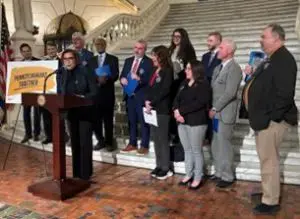
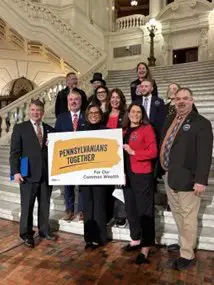
Harrisburg, PA—Today, the Pennsylvania Policy Center (PPC), alongside legislators and partners from across the Commonwealth, held a press conference and advocacy day at the state Capitol calling for fair taxes and a responsible state budget that meets the needs of Pennsylvania families.
The event coincided with the release of PPC’s latest policy brief, “The Public Investment Deficit,” which finds that Pennsylvania’s ongoing budget challenges are driven not by excessive spending but by a revenue system that has failed to keep pace with rising costs and longstanding public needs.
Read the full report here: https://pennpolicy.org/research_publication/public-investment-deficit/.
At a time when working families are facing rising costs for housing, health care, child care, utilities, and basic necessities, Pennsylvania is leaving up to $6.2 billion on the table each year because our tax system fails to require that multimillionaires, billionaires, and large corporations pay their fair share.
At the same time, the state is projecting multi-billion-dollar budget shortfalls and drawing down its Rainy Day Fund to maintain current services.
“Pennsylvania is not a poor state, but it is one of the worst states to be poor in,” said Felicity Williams, executive director of the Pennsylvania Policy Center. “At the same time that families are struggling to keep up, Pennsylvania billionaires are getting richer. We have the resources to invest in our communities. What we lack is a tax system that asks everyone to contribute their fair share.”
The report makes clear that without new, recurring revenue, Pennsylvania will face continued deficits, shrinking reserves, and growing pressure on essential services.
A Growing Public Investment Deficit
The new report outlines how years of underinvestment have created a structural gap between what Pennsylvanians need and what the state is able to provide. Pennsylvania faces a growing public investment deficit driven not by excessive spending but by a revenue system that has failed to keep pace with the cost of maintaining core public services.
Key findings include:
- Pennsylvania’s budget challenges are driven by insufficient revenue growth, not overspending.
- Temporary federal relief masked structural issues that are now re-emerging.
- The state faces projected multi-billion-dollar deficits in the coming years. Inflation-adjusted General Fund expenditures have grown only modestly over time, while revenues have failed to keep pace with public needs and projected costs.
- Federal cost-shifting is increasing pressure on state resources. As federal support is reduced and more responsibility is pushed onto Pennsylvania, the Commonwealth will need stable, new, recurring revenue to prevent deeper cuts and meet both longstanding and emerging needs.
- The affordability crisis is intensifying the consequences of underinvestment as families face rising costs for housing, child care, health care, food, and transportation at the same time that public systems are under increasing strain.
This “public investment deficit” is visible across core systems, including education, health care, infrastructure, and child care, where funding has not kept pace with demand.
A Responsible Budget Requires Fair Taxes
Speakers at today’s press conference emphasized that Pennsylvania’s fiscal challenges cannot be solved through cuts and called for modernizing the state’s tax system to generate sustainable revenue. They underscored that tax fairness is about creating the conditions for long-term, sustainable growth by making sure we have the revenue to invest in what actually drives economic success.
Participating lawmakers included:
- Senator Art Haywood (SD-4, Philadelphia)
- Representative Elizabeth Fiedler (HD-184, Philadelphia)
- Representative Kyle Donahue (HD-113, Lackawanna County)
- Representative Tarah Probst (HD-189, Monroe & Pike Counties)
The following additional legislators joined the press conference in support of these efforts, underscoring growing momentum in the General Assembly for a more equitable and sustainable revenue system: Senators Lindsey Williams (SD 38), Tim Kearney (SD 26), and Marty Flynn (SD 22), and Representative Jim Haddock (HD 188).
They were joined by advocates and coalition partners from across Pennsylvania, including Action Together NEPA, Hope & Action Consulting, Fairness Pennsylvania, Transit for All PA, Planned Parenthood, MomsRising, and Affordable Pennsylvania.
Together, speakers highlighted the urgent need to invest in:
- Strong public schools
- Affordable health care and child care
- Reliable public transit
- Thriving communities across the Commonwealth
What Comes Next
Today’s event is part of the For Our Common Wealth campaign, a growing statewide movement to advance fair tax policies and ensure Pennsylvania has the revenue needed to invest in its people and economy.
With budget negotiations underway and Tax Day approaching, advocates and lawmakers are calling for bold action to build a more equitable and sustainable fiscal future.
They were joined by advocates and coalition partners from across Pennsylvania, including Action Together NEPA, Hope & Action Consulting, Fairness Pennsylvania, Transit for All PA, Planned Parenthood, MomsRising, and Affordable Pennsylvania.
Together, speakers highlighted the urgent need to invest in:
- Strong public schools
- Affordable health care and child care
- Reliable public transit
- Thriving communities across the Commonwealth
What Comes Next
Today’s event is part of the For Our Common Wealth campaign, a growing statewide movement to advance fair tax policies and ensure Pennsylvania has the revenue needed to invest in its people and economy.
With budget negotiations underway and Tax Day approaching, advocates and lawmakers are calling for bold action to build a more equitable and sustainable fiscal future.
###