A Data-Driven Fact Sheet on Affordability, Immigration, and Voting Access
Pennsylvania Policy Center | March 2026
Executive Summary
In his State of the Union address, President Donald Trump described an economy in rapid improvement, falling prices, and strengthened public systems. However, data show that many Pennsylvanians continue to face rising costs for housing, food, health care, and energy.
While inflation has moderated from its peak, prices remain significantly higher than before the pandemic. Food, housing, energy, and health care costs continue to strain household budgets. Meanwhile, proposed federal policy changes to food assistance, health coverage, voting access, and immigration enforcement risk increasing instability rather than reducing it.
This fact sheet contrasts key claims from the address with publicly available economic and policy data and outlines what these realities mean for working families across Pennsylvania. At a time when affordability remains the top concern for voters, it is critical that policymakers ground decisions in facts rather than rhetoric.
Affordability and the Economy
Prices and Inflation
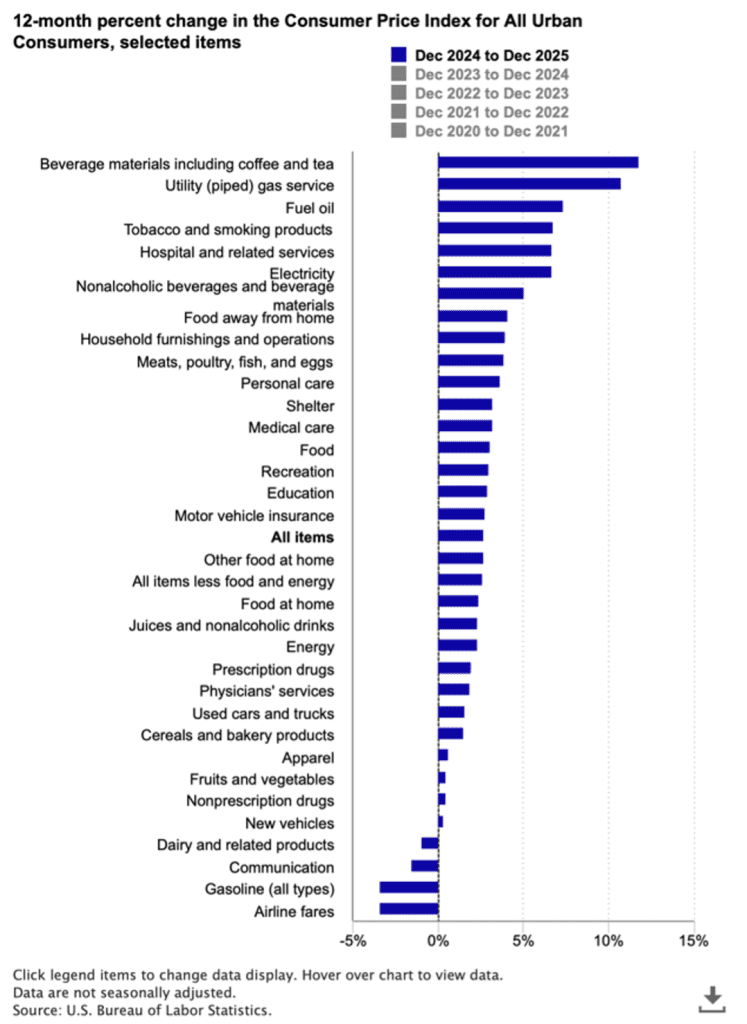
President Trump claimed that prices are “plummeting downward.” However, the Consumer Price Index (CPI) for all items rose 2.7% from December 2024 to December 2025. Food prices increased 3.1%, reflecting a 2.4% increase in prices for food at home and a 4.1% increase in prices for food away from home
For the Philadelphia–Camden–Wilmington metro area, the CPI for all items, excluding food and energy, rose 3.7% over the year. The energy index increased 10.6%, and the food index was up 2.2% over the same period.[1]
Figure 1: 12-Month Percent Change in the Consumer Price Index for All Urban Consumers, selected items
Source: U.S. Bureau of Labor Statistics, “Consumer Price Index: 2025 in review,” The Economics Daily.
What This Means for Pennsylvanians
Although inflation has slowed compared to peak pandemic levels, prices remain elevated. The costs of many essential goods and services continue to rise faster than wages for low- and middle-income households. Even modest increases compound financial strain for families already navigating higher housing, transportation, and child care costs.
Gas Prices
The President claimed gas prices are now below $2.30 per gallon in most states. In reality, as of February 25, the national average is $2.975 per gallon. In Pennsylvania, drivers are paying an average of $3.127 per gallon at the pump, and prices are higher in parts of northwestPennsylvania, including Erie, Crawford, and Warren Counties, where average prices range from $3.288 to $3.336 per gallon (Erie: $3.336; Crawford: $3.317; Warren: $3.288).[2]
What This Means for Pennsylvanians
Transportation remains one of the largest household expenses. For working families who commute long distances or rely on personal vehicles due to limited transit options, higher gas prices directly reduce disposable income.
Housing Costs
President Trump claimed that “the annual cost of a typical new mortgage is down almost $5,000.” However, available indicators suggest a much smaller change.
Redfin estimates the median U.S. monthly housing payment was down by about $1,680 per year, not $5,000, partly due to lower mortgage rates. However, mortgage rates alone do not determine monthly housing payments; payments are also driven by home prices. Nationally, home prices rose 1.7% in 2025 compared with 2024 (about $7,400 higher).[3] In Pennsylvania, home prices rose even more, increasing 4.8% in 2025 compared with 2024.[4]
As a result, even with mortgage rates declining year over year, any reduction in a “typical” Pennsylvania mortgage payment would likely be modest, closer to hundreds, not thousands, of dollars annually, if it declines at all, depending on the home price and down payment.
What This Means for Pennsylvanians
Housing affordability remains one of the most pressing challenges in the Commonwealth. Higher income prices, limited supply, and elevated rents continue to strain working families. Small reductions in mortgage rates do not offset structural affordability pressures.
Food Assistance and SNAP
President Trump claimed his administration has “lifted 2.4 million Americans … off of food stamps,” framing reduced SNAP enrollment as evidence of improving economic conditions.
However, rather than improved economic stability, food costs remain elevated, and policy changes have expanded work requirements and administrative hurdles that increase the risk that eligible families lose assistance due to added paperwork and administrative barriers.[5]
In Pennsylvania:
- SNAP benefits are reduced while grocery prices remain high.
- Nearly 2 million Pennsylvanians currently rely on SNAP.
- Approximately144,000 are expected to lose food assistance under recent changes.[6]
What This Means for Pennsylvanians
Declining SNAP participation does not currently reflect reduced need. When red tape increases, eligible households can lose access to food assistance despite ongoing hardship. In a state where food insecurity remains a concern, policy changes that increase administrative barriers risk worsening hunger.
Health Care and Coverage Losses
President Trump claimed his administration is “bringing [costs] way down” through a new health plan and “maximum price transparency.” He also claimed Americans will now pay “the lowest price anywhere in the world” for prescription drugs. However, few implementation details were provided.
At the same time, the One Big Beautiful Bill Act (OBBBA) allowed the enhanced Affordable Care Act (ACA) premium tax credits to expire and added new administrative barriers.
In Pennsylvania, the damage is already visible:
- During Pennie’s 2026 Open Enrollment Period, approximately 85,000 people dropped coverage.
- For those who remained enrolled, the average monthly premium more than doubled, increasing by approximately 102%.[7]
- Beyond higher marketplace premiums and coverage losses, OBBBA-related Medicaid cuts and eligibility changes are estimated to lead to between 375,000 and 576,000 Pennsylvanians losing health coverage.[8]
What This Means for Pennsylvanians
When enhanced federal premium tax credits expired, marketplace coverage became significantly more expensive for many working- and middle-class families. Combined with Medicaid eligibility changes, these shifts increase the risk of coverage losses, higher uncompensated care costs for hospitals, and greater financial instability for households facing medical emergencies.
Immigration and Community Stability
As President Trump continues to frame immigration as a driver of crime and public safety risks, he called for new restrictions and penalties, including ending “sanctuary cities.” For context, while only Philadelphia has been identified by the U.S. Department of Justice as a “sanctuary jurisdiction,”[9] other localities across the state have adopted similar “welcoming” or non-cooperation policies, including Pittsburgh’s “Unbiased Policing” policy and Allentown’s non-collaboration approach.[10]
He also proposed the “Dalilah law,” which would prohibit states from granting commercial driver’s licenses to undocumented immigrants. These proposals would expand federal enforcement pressure on states and localities, increasing fear and instability in communities, and in the process, could discourage people from reporting crimes, seeking medical care, or engaging with schools and other public institutions.
What This Means for Pennsylvanians
Immigrants are integral to Pennsylvania’s workforce, including in health care, agriculture, hospitality, and construction. Policies that increase fear and instability can discourage individuals from reporting crimes, seeking medical care, or engaging with schools and public institutions. Workforce participation and local economies can be negatively affected when communities experience heightened enforcement pressure.
Voting Access and Election Claims
During the address, President Trump made numerous claims about election integrity and voting access. He asserted that “cheating is rampant” and tied that claim to allegations of noncitizen voting. He called on Congress to pass the “Safe America Act,” requiring voter ID and proof of citizenship to vote, and he argued for restricting mail voting to limited circumstances such as illness, disability, military service, or travel.
The reality is that these claims are not supported by evidence: Voting by noncitizens in federal elections is already illegal and documented instances are extraordinarily rare.
What is true is that proof-of-citizenship requirements can create significant barriers for eligible voters, especially when a voter’s current legal name does not match the name on their birth certificate or other citizenship documents.
While Pennsylvania does not publish a single statewide count, Philadelphia alone processed 478 name-change petitions in 2023.[11]
Pew Research Center finds that about 79% of women in opposite-sex marriages report taking their husband’s last name (while men overwhelmingly keep theirs).[12]
Similarly, proof-of-citizenship requirements can disproportionately burden other eligible voters who are more likely to lack ready access to documents or face higher logistical barriers, including[13]
- low-income voters who may not have passports and for whom replacement documents can be costly or time-consuming.
- older adults, especially those born at home or in places where birth records are harder to obtain.
- voters of color, who surveys find are more likely to lack ready access to documentary proof of citizenship.
- transgender people and others who have changed their legal name and would need extra documentation to reconcile records.
Administrative and Fiscal Implications
Implementing proof-of-citizenship requirements would require significant updates to voter registration systems, document verification processes, and staff training. Counties would bear substantial administrative costs. Eligible voters could face delays or erroneous removal from voter rolls due to document mismatches, increasing litigation risk and administrative complexity.
What This Means for Pennsylvanians
Election policy changes should be grounded in evidence and carefully evaluated for administrative feasibility, fiscal impact, and unintended consequences. Policies that increase barriers for eligible voters risk undermining participation without addressing actual problems.
Conclusion: Grounding Policy in Reality
Pennsylvanians deserve policies rooted in accurate data and lived experience. While national rhetoric may present a picture of falling prices and widespread economic improvement, many families across the Commonwealth continue to navigate higher housing costs, food insecurity, rising health premiums, and economic uncertainty.
As Congress and the Pennsylvania General Assembly debate budget priorities, tax policy, health care, and public assistance programs, the focus should remain on practical, evidence-based solutions that lower costs, protect access to essential services, and ensure economic growth benefits working families across Pennsylvania.
Affordability is not a slogan. It is a measurable reality shaped by policy decisions. And those decisions matter for every community in the Commonwealth.
[1]. U.S. Bureau of Labor Statistics, “Consumer Price Index, Philadelphia–Camden–Wilmington, PA–NJ–DE–MD,” U.S. Bureau of Labor Statistics, accessed February 25, 2026, https://www.bls.gov/regions/mid-atlantic/news-release/consumerpriceindex_philadelphia.htm.
[1]. AAA, Pennsylvania Average Gas Prices (regular unleaded and metro averages), AAA Fuel Prices, accessed February 26, 2026, https://gasprices.aaa.com/page/26/?state=PA.
[2]. National Association of Realtors, “Median Sales Price of Existing Single-Family Homes (Dec 2025), up 1.7% from 2024,” FRED (Federal Reserve Bank of St. Louis), accessed February 26, 2026, https://fred.stlouisfed.org/series/HSFMEDUSM052N.
[3]. Redfin, “Pennsylvania Housing Market: House Prices and Trends,” Redfin, accessed February 25, 2026, https://www.redfin.com/state/Pennsylvania/housing-market.
[4]. Katie Bergh and Dottie Rosenbaum, “Congressional Delay of SNAP Cost Shift Urgently Needed to Protect Food Assistance for Low-Income Families,” Center on Budget and Policy Priorities, January 8, 2026, accessed February 25, 2026, https://www.cbpp.org/research/food-assistance/congressional-delay-of-snap-cost-shift-urgently-needed-to-protect-food.
[5]. Marc Stier and Laura Beltrán Figueroa, “The OBBBA Reconciliation Bill: a Threat to Food Assistance in Pennsylvania,” Pennsylvania Policy Center, October 11, 2025, https://pennpolicy.org/research_publication/the-trump-republican-reconciliation-bill-a-threat-to-food-assistance-in-pennsylvania/.
[6]. Pennie, “One in Five Pennie Enrollees Drop Health Coverage Due to Expired Federal Tax Credits,” February 9, 2026, https://agency.pennie.com/one-in-five-pennie-enrollees-drop-health-coverage-due-to-expired-federal-tax-credits/.
[7]. Laura Beltrán Figueroa, “From Progress to Peril: OBBBA’s Threat to Health Care in Pennsylvania,” Pennsylvania Policy Center, October 18, 2025, https://pennpolicy.org/research_publication/from-progress-to-peril-health-care-under-trump/.
[1]. U.S. Department of Justice, “Justice Department Publishes List of ‘Sanctuary Jurisdictions,’ ” press release, September 4, 2020, accessed February 25, 2026, https://www.justice.gov/opa/pr/justice-department-publishes-list-sanctuary-jurisdictions.
[1]. City of Allentown, Pennsylvania, “Welcoming City Designation” (municipal code), accessed February 26, 2026, https://ecode360.com/46085096.
[1]. First Judicial District of Pennsylvania, 2023 Annual Report, The Philadelphia Courts, accessed February 25, 2026, https://www.courts.phila.gov/pdf/report/2023-First-Judicial-District-Annual-Report.pdf.
[1]. Pew Research Center, “About Eight-in-Ten Women in Opposite-Sex Marriages Say They Took Their Husband’s Last Name,” Pew Research Center, September 7, 2023, accessed February 25, 2026, https://www.pewresearch.org/short-reads/2023/09/07/about-eight-in-ten-women-in-opposite-sex-marriages-say-they-took-their-husbands-last-name/.
[1]. Brennan Center for Justice, “21.3 Million American Citizens of Voting Age Don’t Have Ready Access to Citizenship Documents,” June 11, 2024, accessed February 26, 2026, https://www.brennancenter.org/our-work/analysis-opinion/213-million-american-citizens-voting-age-dont-have-ready-access.